Medical Emergency XR Simulation — VR Healthcare Training
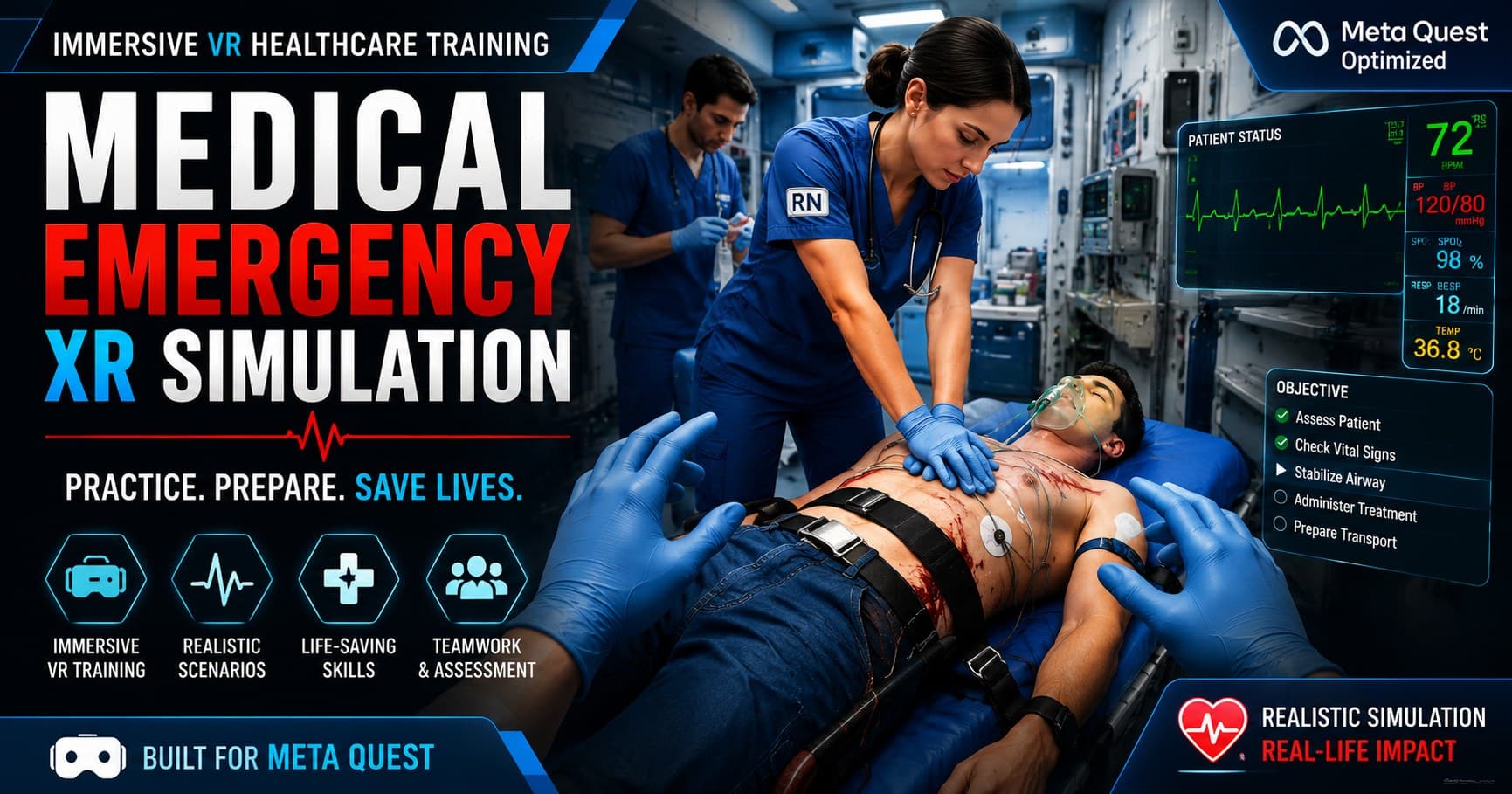
Immersive VR healthcare training platform for Meta Quest — practice CPR, defibrillation, diagnostics, and emergency response.

Loads in browser | Quest / Link / Virtual Desktop ready
Best experienced on Meta Quest. Open directly in Quest Browser, or use a WebXR-compatible desktop browser with Meta Quest Link / Virtual Desktop.
Scan to launch this WebXR demo in headset.
Scan the QR code with your phone or Meta Quest, then open this page in Meta Quest Browser. It also works through a WebXR-compatible desktop browser with Meta Quest Link or Virtual Desktop.
https://www.machsquare.com/portfolio/medical-emergency-xr-simulationWant this training system for your hospital or institute?
We can adapt the Medical Emergency XR engine to your curriculum, clinical protocols and deployment setup, from a pilot Quest rollout to a white-label training program.
An immersive VR healthcare training platform for Meta Quest. Trainees practice CPR, defibrillation, patient diagnostics, and emergency response in realistic clinical scenarios — voice-guided, hands-on, infinitely repeatable. Built for hospitals, nursing institutes, and medical schools that need scalable procedural training.
Why hospitals and medical institutes adopt it
| Pain point | What it delivers | |---|---| | Limited live emergency exposure | Unlimited, repeatable VR scenarios on any Meta Quest headset | | Expensive mannequin lab time | Headset-per-trainee model that scales to whole cohorts | | Can't safely rehearse high-stakes procedures | Risk-free CPR, defibrillation, and trauma rehearsal | | Inconsistent practical training | Standardized, measurable scenarios for every learner | | Hard to assess decision-making | Step-by-step procedure tracking and decision logging |
What trainees can practice
- CPR procedures — chest compression workflows with timing feedback
- Defibrillation — equipment handling, pad placement, shock sequencing
- Patient diagnostics — symptom interpretation and decision-making
- Medication and treatment selection — consequence-aware patient response
- Vital monitoring — pulse, oxygen, and patient state in real time
- Nerve response checks and neurological assessment
- Voice-guided emergency scenarios with branching outcomes
How it's built
Unity 6 on Meta Quest 2 and Quest 3, with a modular medical simulation framework. Patient conditions, vitals, and emergency triggers run on a clean event model so new scenarios are content work, not engineering work. The pick-up / use / treat / monitor interaction pattern is reused across every module. Runs fully offline on the headset — deployable in clinical settings with restricted connectivity.
A real-time audio guidance system mirrors how senior clinicians coach junior staff ("Patient pulse is dropping" · "Begin CPR immediately" · "Use the defibrillator"), paired with world-space VR UI for objectives, vitals, and step-by-step prompts.
Bring it to your institution
I work directly with hospitals, medical schools, nursing institutes, and ed-tech partners to deploy and extend the platform:
- Pilot program — Quest deployment, curriculum mapping, instructor onboarding
- Custom scenarios — regional clinical protocols or accreditation-aligned modules
- White-label licensing — your branding, your content, our engine
- Co-development — joint roadmap for specialty training (ICU, trauma, anesthesia, pediatric, paramedic)
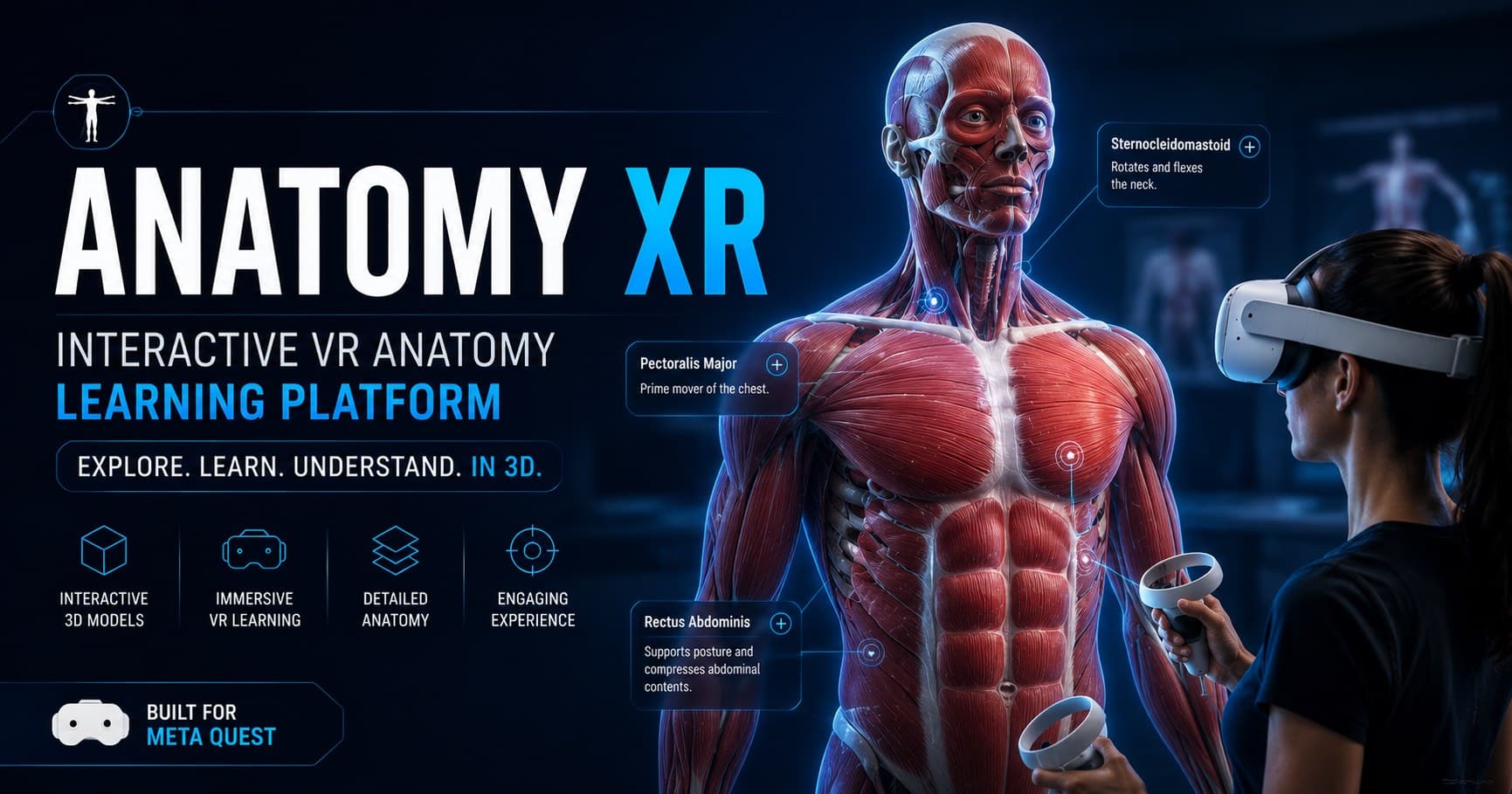
It complements Anatomy XR and the specialist MuscleLab XR forearm anatomy module to form a complete medical XR education suite — foundational anatomy, regional musculoskeletal depth, and procedural emergency rehearsal.
Roadmap — what's coming next
- AI medical instructor — conversational guidance and adaptive coaching
- Multiplayer training — multi-trainee scenarios with instructor presence
- Instructor monitoring dashboard — observe, intervene, review performance
- Medical analytics and scoring — measurable competency tracking
- Hand tracking support — controller-free natural medical procedures
- Scenario editor — educators author custom scenarios without code
- Certification tracking for accredited training programs
- Advanced trauma simulations — mass casualty, polytrauma, surgical emergencies
- Haptic interaction for higher-fidelity procedural feedback
- Voice recognition for trainee-spoken medical commands
FAQ — Does it work on Meta Quest 2 and Quest 3?
Yes. The platform is optimized for both, with adaptive rendering to maintain stable framerate. Quest 3 unlocks higher-fidelity visuals and is the recommended option for full clinical realism.
FAQ — Can we add our own scenarios or clinical protocols?
Yes. A scenario editor is on the active roadmap, and custom scenarios are available today through co-development. Hospitals can have their regional protocols, hospital-specific workflows, or accreditation-mapped scenarios built directly into the platform.
FAQ — Can the platform be white-labelled?
Yes. White-label licensing covers your institution's branding, clinical content, and accreditation alignment running on the Medical Emergency XR engine.
FAQ — Does it require an internet connection?
No. The platform runs fully offline on the Meta Quest headset — no cloud streaming, no per-session licensing servers. Deployable in environments with limited or restricted connectivity.
FAQ — How does VR training compare to mannequin training?
VR emergency simulation complements mannequin and live training rather than replacing them. It increases repetitions per trainee, lowers cost per scenario, and lets students rehearse high-stakes procedures safely before supervised practice. Institutions typically position VR between classroom theory and live rotations.